78th minute. 0–0. Not a single shot on goal since half-time.
Your team are pressing. The game has been playing out in the other half for half an hour. You’re standing on the edge of the penalty area, your hands cold, your mind somewhere between the pitch and the final whistle. A turnover in midfield. A long ball. Suddenly, there’s a striker, all on his own, sprinting towards you.
Now there’s only one question that matters: are you there, or do you still have to get there?
The save takes a split second. It’s decided in the minutes leading up to it, when nothing was happening. That’s exactly what concentration means in goalkeeping.
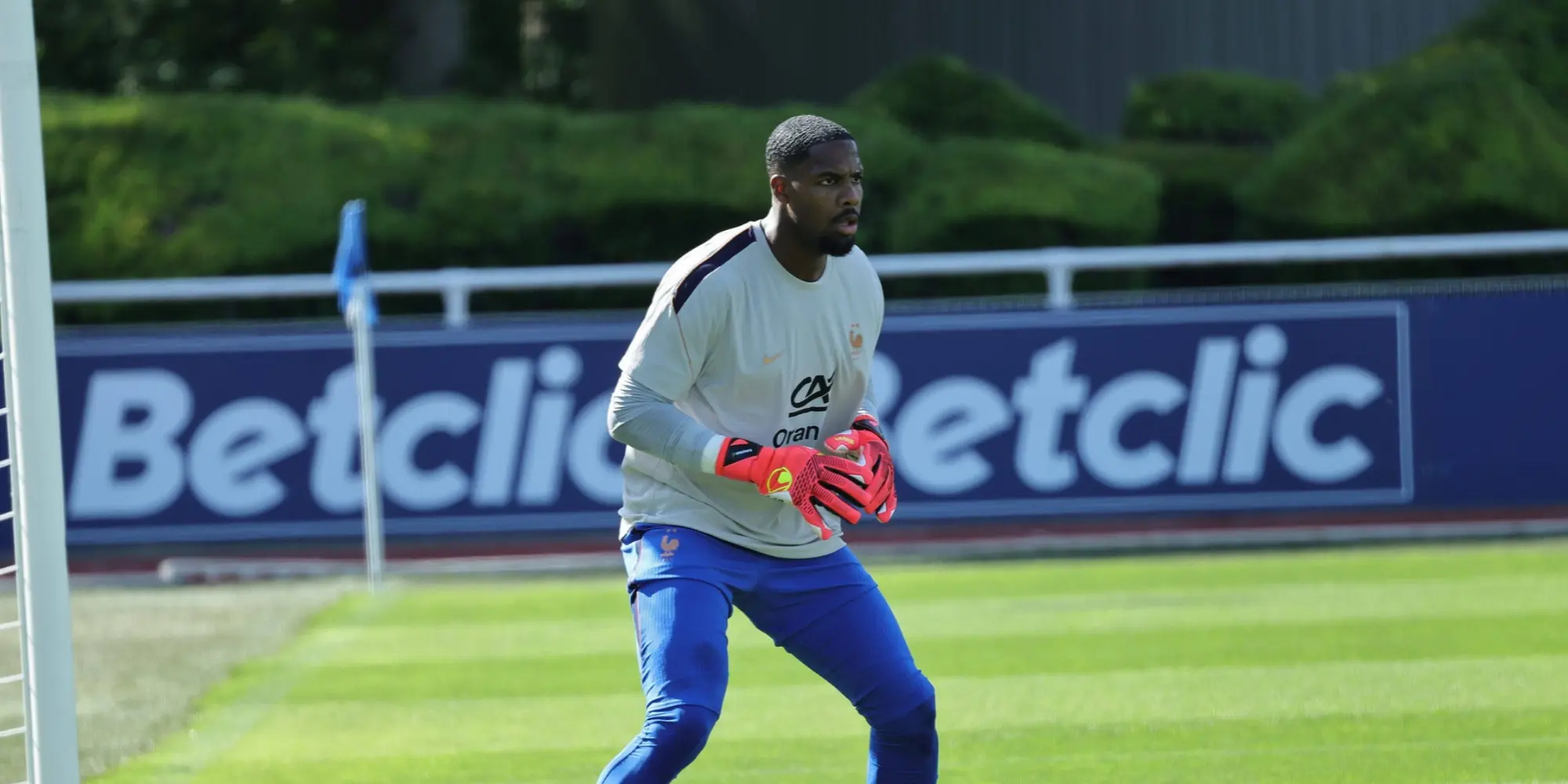
Why concentration works differently for goalkeepers
A field player is constantly in the thick of the action. He runs, presses, receives passes. His mind is automatically engaged.
Not you. As a goalkeeper, in many matches you only have a handful of genuine saves to make. The rest is observing, positioning and coaching. And this is precisely where the problem lies: the most dangerous phase isn’t the one where a lot is happening. It’s the one where nothing happens for a long time.
If you switch off for 80 minutes, it’ll take you too long to get back into it in the 81st minute. And you don’t have that time.
Why this is important: concentration isn’t a switch that stays ‘on’ for 90 minutes. Nobody can maintain full concentration for that long. The best players know when to ramp up their focus and when they can ease off in a controlled manner, without ever switching off completely.
The four concentration zones in the goal
Concentration isn’t simply ‘paying attention’. It has a direction and a scope. As a goalkeeper, you’re constantly switching between four ‘windows’.
Wide and outwards. The ball is in the opposition’s half. You scan the whole pitch: where is your back line? Is there a striker lurking behind the defence? Which areas are open? Here, you’re the organiser.
Narrow and outwards. The ball is heading towards the penalty area. Your focus narrows to the player on the ball, their shooting foot and their body posture. Everything else becomes irrelevant.
Tight and inwards. The moment before the shot or the penalty. Breathing, body tension, split step. You assess yourself in a fraction of a second.
Wide and inwards. After the action. Saved, fumbled, conceded a goal. Now you briefly assess what’s happened and put it behind you. This is where it’s decided whether the next ball will come your way cleanly again.
Why it works: If you know the ‘windows’, you can switch between them deliberately rather than by chance. A goalkeeper who, when the ball is in midfield, is already staring intently at the player on the ball will overlook the run that ultimately leads to the goal.
Coaching is your best trick for staying focused
The easiest way to stay in the game: talk. If you’re constantly giving information, you have to be constantly taking it in. You can’t shout “Man behind you” to your centre-back if you haven’t seen the man behind you.
Coaching forces you to stay alert, precisely when the risk of zoning out is at its greatest. At the same time, you organise your defence in such a way that dangerous situations don’t arise in the first place.
Why it works: Your mind stays active without you wasting energy on constant tension. Concentration through engagement rather than through tension.
The reset: Regaining concentration after a mistake
A goal conceded, a ball slipping through your hands, a missed run off his line. The most dangerous thing about it isn’t the mistake itself, but the next five minutes. If your mind is still on the last ball, you’ll be too late for the next one.
That’s why professionals stick to set reset routines. A short ritual, always the same, that brings the mistake to a close: clap your gloves together, take a deep breath, glance at the crossbar, say a key phrase like ‘Next one’. It doesn’t matter what you do. What matters is that you always do it the same way.
Why it works: A set ritual sends a clear signal to your mind that the situation is over. You replace overthinking with an action, and actions can be practised.
The most common mistakes made when practising concentration
Constant shots in training. When a shot comes every ten seconds, you’re automatically on your toes. In a match, a shot comes every ten minutes. If you never practise when things are quiet, you’ll never learn to react when things are quiet.
Full concentration from the 1st to the 90th minute. If you’re constantly on edge, you’ll be mentally drained after an hour. Which is exactly when matches are decided.
Standing silently in goal. Without coaching, you lack the natural anchor that keeps you in the game.
Dwelling on the mistake. If you overthink after a blunder instead of resetting, you often turn one mistake into two.
Expecting concentration only during the match. What you don’t practise in training won’t be there when you need it at the weekend. This applies just as much to your mental game as it does to your diving technique.
3 drills to improve concentration in goal
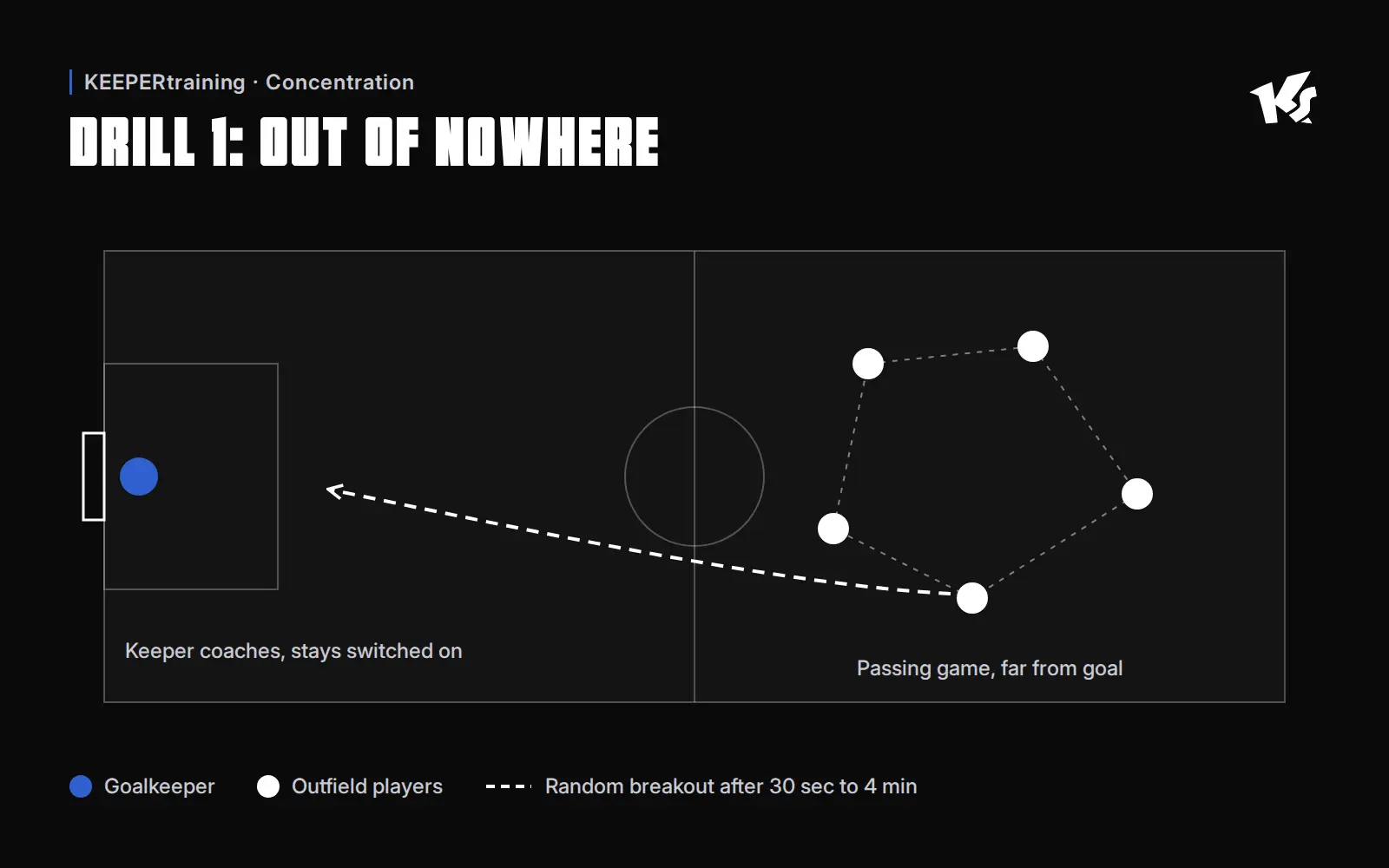
Drill 1: Out of nowhere
Set-up: Outfield players practise passing drills or a game situation on the other side of the pitch. The goalkeeper stands in goal and coaches without being on the ball.
Procedure: At a random moment – sometimes after 30 seconds, sometimes after four minutes – a player breaks away and runs towards the goal with the ball. The goalkeeper must react immediately, either coming off his line or saving the shot.
Why it works: You’re practising exactly what’s most difficult in a match. Not the save itself, but the transition from a state of calm to full action.
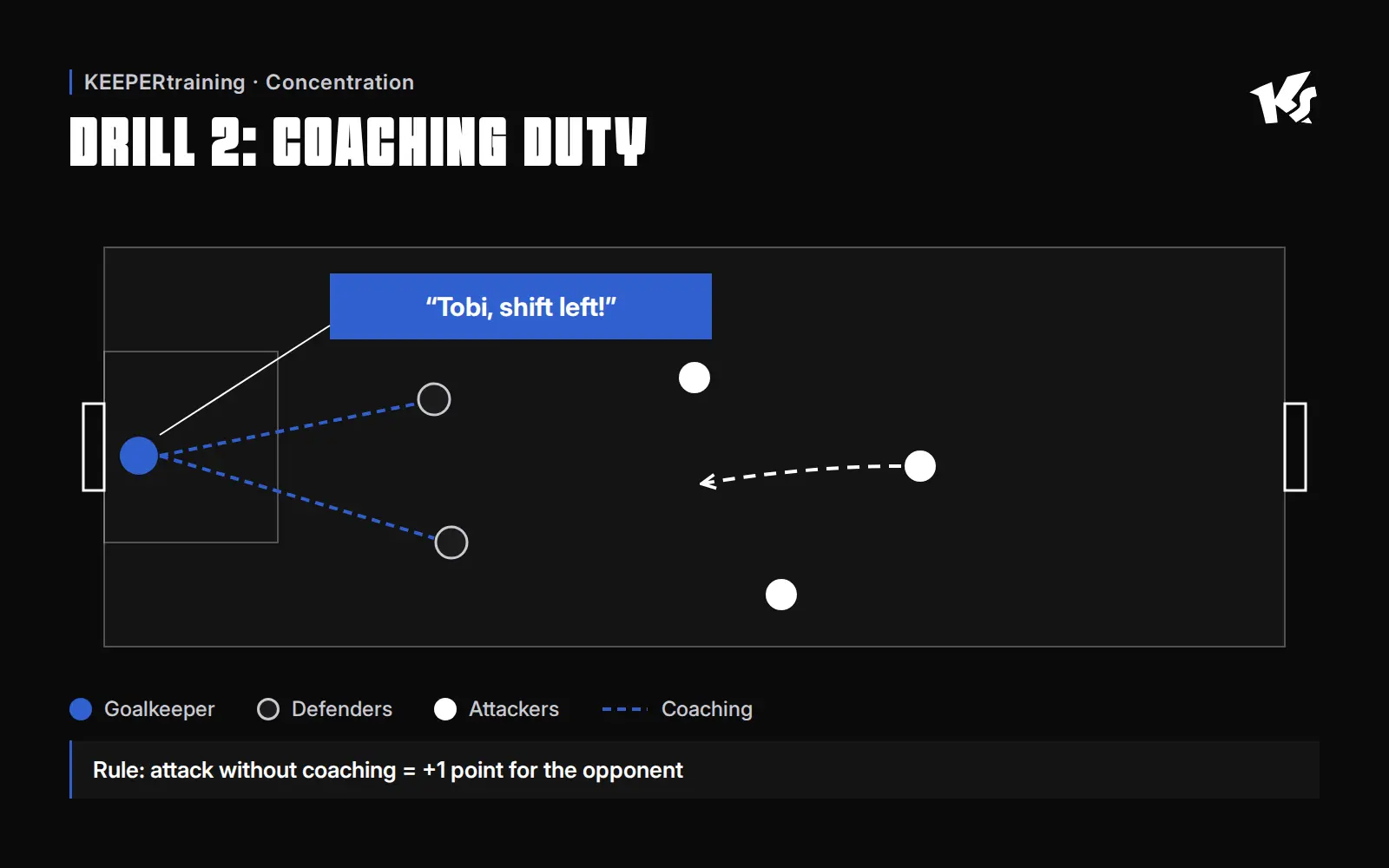
Drill 2: Compulsory coaching
Set-up: Small-sided game with a goalkeeper. The goalkeeper must give at least one clear instruction during every opposition attack: a name plus a piece of information (“Tobi, move to the left!”).
Procedure: If the goalkeeper forgets to give instructions, the opposition scores an extra point for that attack. A coach or teammate keeps score.
Why it works: Coaching goes from being a nice extra to an essential part of your game. You stay within the wide window and learn to read the game before it becomes dangerous.
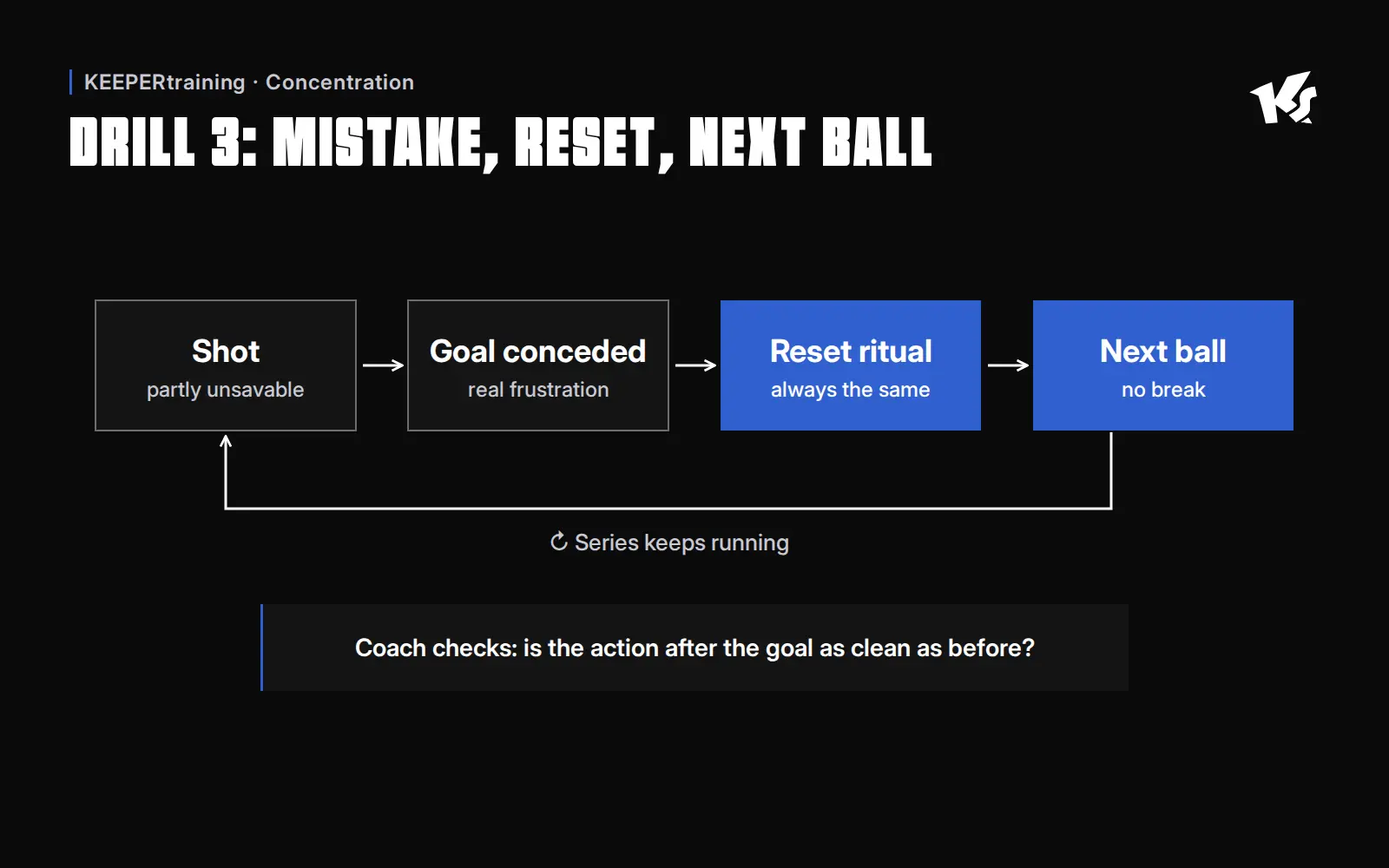
Drill 3: Mistake, reset, next ball
Set-up: The coach shoots a series of shots from different positions. Some shots are deliberately difficult to save: deflected, from close range, into the corner.
Procedure: After conceding a goal, the goalkeeper performs their reset ritual. Immediately afterwards, without a break, the next ball comes. The coach checks whether the action after conceding a goal is just as clean as before.
Why it works: You link your ritual to real frustration and real time pressure. That way, it’ll come naturally in a match when you really need it.
Your concentration checklist
✅ Incorporate deliberate rest periods into training; don’t just keep going
non-stop ✅ Be aware of the four concentration windows and switch
between them deliberately ✅ Use coaching as a tool to stay
in the game ✅ Develop a fixed reset routine and practise
it under pressure during training ✅ Pace your concentration: ramp it up when the ball comes, but never switch off completely
Conclusion: The move starts in your head, long before the ball comes into play
That save in the 78th minute doesn’t just happen in the 78th minute. It’s built up over the 77 minutes leading up to it, during which you stayed in the game even though the action was happening elsewhere.
Concentration isn’t a natural talent. It’s a skill that you can train just as much as your falling technique or reaction time. Anyone who practises ‘idling’, ‘coaching’ and ‘resetting’ in a focused way doesn’t need to find their rhythm at the crucial moment. They’re already there.
Always stay up to date
Frequently asked questions about concentration in goalkeeping
How do I stay focused when I’ve got nothing to do for a long time?
Keep yourself busy without getting tense. Guide your defence, constantly adjust your position in relation to the ball and keep moving. If you’re playing rather than watching, you won’t lose focus.
Is it even possible to train your concentration?
Yes. Concentration depends heavily on what you regularly experience in training. If you practise dealing with periods of inactivity, distractions and mistakes in a targeted way, you’ll be able to draw on that during a match.
What should I do immediately after conceding a goal?
Your reset ritual. Brief, always the same, and then consciously looking ahead. Analysing the mistake is something for the debrief, not for the next minute of play.
Does having a set pre-match routine help?
Yes. Following the same warm-up routine every time will reliably help you reach your peak concentration, whether it’s a friendly or a final.
At what age should one start specifically training one’s concentration?
Start with a playful approach even at youth level, for example through coaching exercises and little rituals. As players get older, targeted drills involving periods of rest and high-pressure situations are introduced.