87th minute. 1–1. The penalty area is packed.
The striker controls the ball with his chest, turns in a flash – and shoots. From five metres out, at mid-height, from a tight angle. No time to think. No time to get into position.
You react and jump. The ball hits the side netting.
You were there.
Not because you were lucky. Not because you guessed where he was shooting. But because, in that moment, your body simply knew what to do – because you’ve trained for exactly this moment.
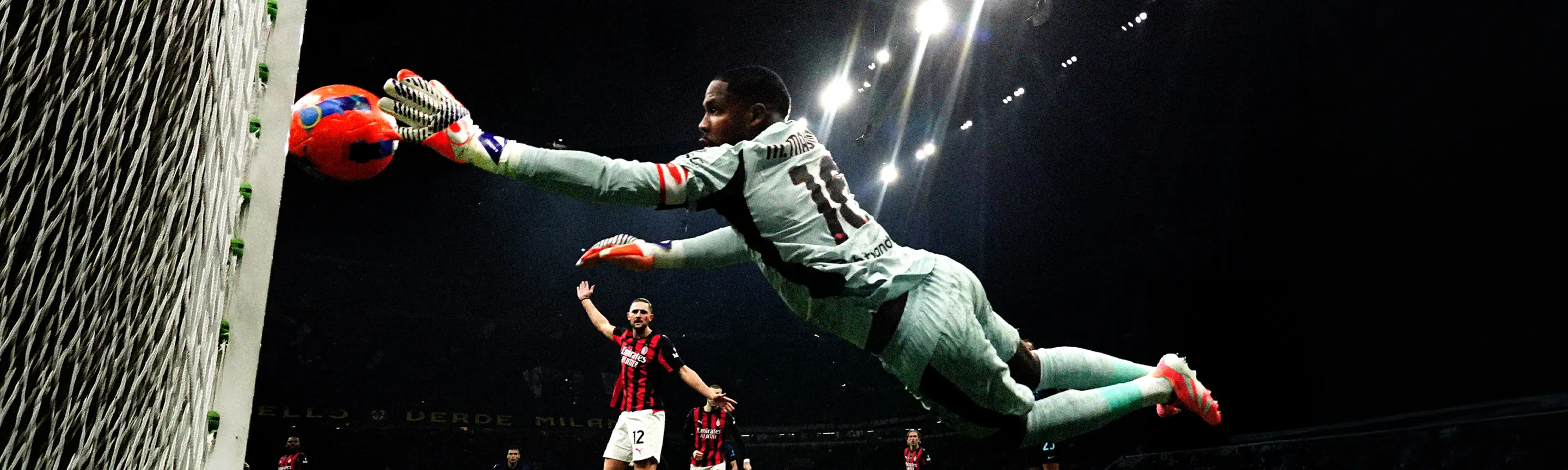
The blink of an eye. That’s all you need.
In modern football, milliseconds separate the hero in goal from the goalkeeper who was a split second too late. Whether it’s a penalty, a follow-up shot or a deflected ball from a scramble – your reaction is what counts. Not your talent. Not your kit. Your reaction.
And here’s the truth that many goalkeepers don’t want to hear: you’re probably training it wrong.
What ‘reaction’ really means
Reaction isn’t a reflex that you either have or don’t have. It’s a three-part process:
1. Perception — You see things sooner because you position yourself better and read the situation.
2. Decision — In a fraction of a second, your brain selects the right response.
3. Execution — Your body implements this decision explosively.
Top goalkeepers like Manuel Neuer or Alisson Becker aren’t “naturally faster”. They have internalised all three components so deeply that they happen automatically. The good news is: this is exactly what can be trained.
The problem with your current training
Let’s be honest: what does your reaction training involve?
The coach shoots. You save it. The coach shoots again. You save it again.
The problem with this is: you know a shot is coming. You know roughly where. Your brain isn’t challenged – it gets complacent.
True reaction skills develop in the face of uncertainty. In a match, you never know what’s coming. Your training needs to reflect that.
Active reaction training means:
- The stimulus is unpredictable-
You make decisions under pressure-
Your body is never at rest
5 exercises that really sharpen your reflexes
1. Colour reaction drill
Set-up: Place 3–4 cones of different colours around the penalty area.
Procedure: The coach calls out a colour – you react immediately, touch the cone, and take a shot shortly afterwards.
Why it works: Your brain is already active, your body in motion. You’re reacting to a real stimulus, not an expected shot.
Intensity: Call out two colours at the same time – only then does the shot come.
2. Distraction saves
Setup: A teammate or dummy blocks the goalkeeper’s view.
Procedure: The shot comes from behind cover – the ball appears late. No warning, no preparation.
This trains exactly what most often decides whether you save or concede in a match: the visual reaction to a ball you only see at the last moment.
3. Reaction Ball Drill
Setup: A reaction ball (an irregularly shaped ball that bounces unpredictably)
Procedure: The coach tosses or throws the reaction ball onto the floor in front of you – you react to the unpredictable bounce and try to stop or control it.
Why it works: No two bounces are the same. Your brain cannot anticipate or plan ahead – it has to react to new information in a fraction of a second. This is exactly what happens in a match with deflected balls, follow-up shots and chaotic penalty area situations.
Advanced version: Reaction ball + immediate shot afterwards. You catch the rebound – and have to reposition yourself in a flash before the next shot comes.
4. Decision-making drill
Set-up: Two mini-goals or marked target zones on the left and right.
Procedure: Just before you shoot, the coach gives a signal (colour, number, hand signal) – and you react in the corresponding direction.
This drill forces your mind and body to work simultaneously. Don’t think, then react – do both at once.
5. 360° reaction
Setup: You stand with your back to the pitch.
Procedure: On a signal, you turn round – and the shot comes immediately.
No time to assess the situation. No prior information. A pure reaction to what you see – and all in a fraction of a second.
What the best do differently
Top goalkeepers don’t just train harder; they train smarter. Here are a few principles you can start applying straight away:
- Never stand still. The split step – a small bounce just before the save – keeps your body engaged and shortens your reaction time
.- Train your eyes. Visual cues and peripheral vision – these are muscles you can train
.- Strengthen your base. Strong legs and a stable core are the foundation for explosive movements. Reaction starts at the foundation
.- Sharpen your focus. The fastest reaction doesn’t come from the body – it comes from a mind that is fully in the moment.
Mistakes to avoid from today onwards
Many goalkeepers waste valuable time in training – because they make these mistakes:
- Too predictable drills: If you know what’s coming, you won’t improve
.- No pressure to make decisions: Without the need to make split-second decisions, you’re only practising movement, not reaction
.- Too far removed from the game: The more the drill resembles a real-life situation, the more effective the training
.- Always the same shots: Variety is the driving force behind development.
Conclusion: Reaction isn’t a talent – it’s hard work
The difference between a goalkeeper who reacts quickly to save the ball from a tight angle and one who is a second too late does not lie in their genes. It lies in their training.
Move away from passively standing in goal. Towards active, unpredictable, game-oriented work on your reflexes.
So: get out onto the pitch and train not just hard, but smart.
Always stay up to date
Read more
:- The goalkeeper as a leader: Why communication decides matches – Goalkeeper communication in detail: The 5 communication styles in
goalkeeping- After a mistake: How goalkeepers deal with moments of mental blackout – What to do when communication has failed and a mistake has been made?
- Modern goalkeeping: The Sweeper-Keeper – Communication is the foundation, but the modern game demands even more.