What the substitution of goalkeeper Antonín Kinsky in March 2026 teaches us about psychology, error culture and the toughest position in football.
As a goalkeeper, you know that feeling. That one moment when suddenly nothing works anymore. One slip-up, one misplaced pass, one goal conceded, and you know: now everyone is looking at you.
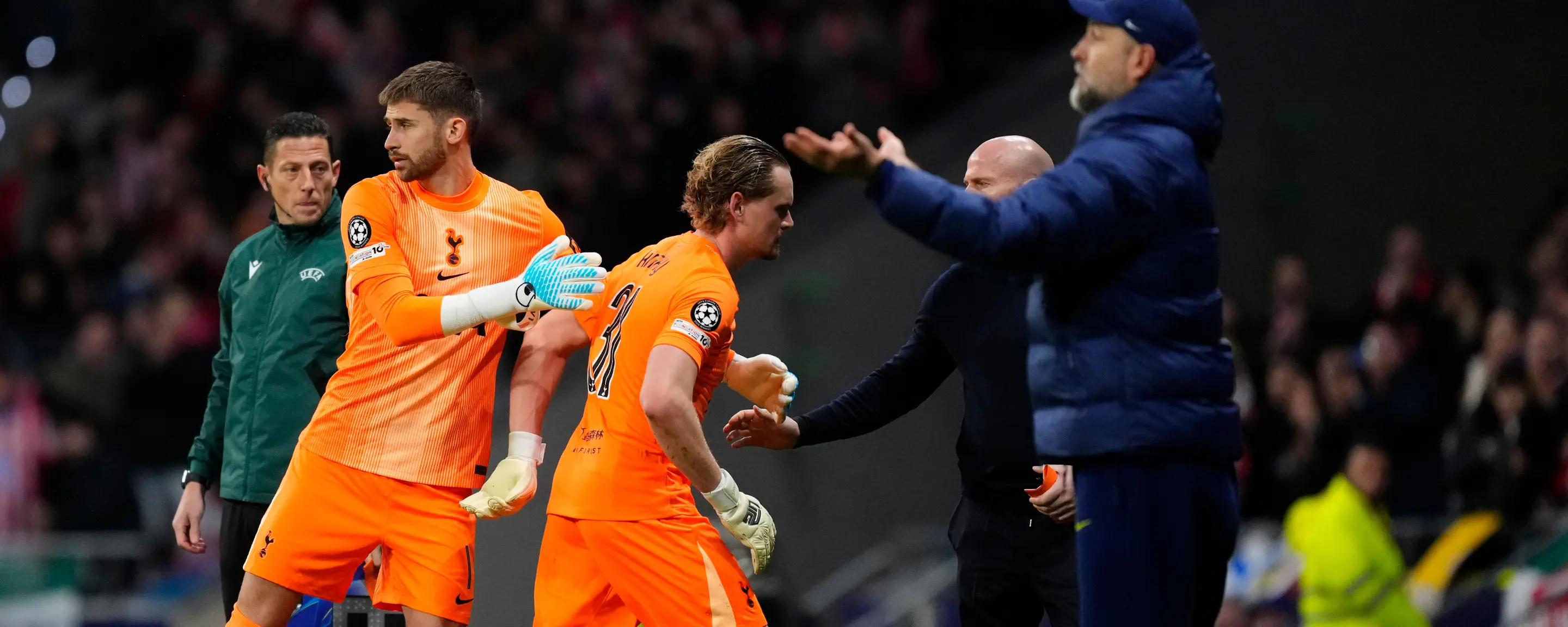
That's exactly what Antonín Kinsky experienced on 10 March 2026 in front of the entire football world. The 22-year-old Tottenham Hotspur goalkeeper was between the posts for the first time in the Champions League in the round of 16 against Atlético Madrid – and had an evening that no goalkeeper would want to forget. Two serious mistakes in less than 15 minutes, three goals conceded directly due to his errors, substitution in the 17th minute. He disappeared into the catacombs in tears. His teammates rushed after him. Even the Atlético Madrid fans gave him encouraging applause.
It was historic. But above all, it was human.
Because almost every goalkeeper has experienced something like this. Maybe not in the Champions League round of 16. But in the district league final, in the decisive youth match, in the first game after a long break. The mistake that sets everything in motion. The feeling that nothing is working anymore. The moment when your head stops helping you.
The special psychology of the goalkeeper
No other player on the pitch is as exposed as the goalkeeper. A mistake by a striker is quickly overlooked in the flow of the game. A goalkeeper's mistake almost always leads directly to a goal against – in front of everyone's eyes, with replays during the half-time analysis.
This structural loneliness is the first thing you have to understand.
David de Gea, long-time Manchester United keeper, summed it up after the Kinsky night: "No one who hasn't been a goalkeeper themselves can understand how difficult it is to play in that position."
Goalkeepers therefore often develop extraordinary mental strength – or they break down at this very point. What makes the difference is not talent. It is how they deal with mistakes.
The mistake loop: if you dwell on a mistake – "Why did I slip? What are the others thinking? Will there be another one?" – you leave the action level and enter the rumination zone. That's exactly where mistakes two and three happen. Not because your technique has deteriorated, but because your head is too loud.
The reset: A goalkeeper's most important tool is a short memory. Not in the sense of repression, but rather: this action is over. The next one starts now.
Should a goalkeeper be substituted after making mistakes?
This question is as old as goalkeeping itself. The Kinsky case has reignited it – and it shows how complex it is.
The argument for the substitution:
Coach Igor Tudor clearly explained his decision: "I've been coaching for 15 years, and I've never done this before. It was necessary to protect the player and the team." When a goalkeeper gets caught in a loop of mistakes and threatens to tip the game, an early substitution can save the whole structure. That's legitimate.
The argument against it:
Peter Schmeichel, one of the best keepers in history, saw it quite differently: "He's substituting him – that will have consequences for the rest of his career. He has absolutely killed his career." A substitution in the 17th minute, publicly and without any visible gesture from the manager, sends a message – not only to the player's subconscious, but to his entire self-image as a goalkeeper.
The crucial question is not "Should I switch?", but "How do I do it?"
A goalkeeper who is substituted without eye contact, without a word, without a gesture – he doesn't just leave the pitch. He leaves with an open wound. A goalkeeper who is substituted with a clear conversation, with dignity, with the signal "You are still part of this team" – he has a chance to process it.
The situation is sometimes unavoidable. The manner is always a choice.
What trainers can do specifically
Mistakes are part and parcel of goalkeeping. How a coach reacts in the minutes that follow shapes a player's self-image in the long term.
A few specific principles: Address the issue directly, don't ignore it. Silence after a mistake is the worst thing. A short, calm conversation – either on the pitch or immediately afterwards in the dressing room – gives the player guidance.
Put mistakes into perspective, don't dramatise them. "It happened, we all know that, now let's look ahead" is not trivialising the situation. It is dealing with reality in a professional manner.
When substituting: do so with dignity. Tudor said after the game that he spoke to Kinsky afterwards. "He understands the moment, he understands why he was taken off. He is a very good goalkeeper. We are all with him." That is the right language – even if it comes after the event.
Team culture is decisive. In Madrid, teammates such as João Palhinha, Conor Gallagher and Dominic Solanke immediately followed Kinsky into the dressing room. That was no coincidence – it was a team that knew what was needed at that moment.
For goalkeepers: How to deal with moments like these
No matter what level you're at, these tools will help.
Reset immediately after every mistake. Develop a personal ritual: take a deep breath, take a firm step forward, give yourself an inner signal. Not to erase the mistake – but to regain your focus.
Analyse, but don't brood. There's a difference between "What happened there and how can I do better next time?" and "Why am I such a bad goalkeeper?" The former will help you progress. The latter will destroy you.
Protect your rhythm. Kinsky hadn't played a competitive match since October – and was then thrown straight into the Champions League round of 16. Playing rhythm is not only important physically, it is also crucial mentally. If you haven't played for a long time, you're not "fresh" – you're tense.
Talk about it. With your goalkeeping coach, with teammates, with a sports psychologist if necessary. Isolation after a bad game is the most dangerous thing. De Gea's statement hits the nail on the head: only those who have stood in goal themselves really understand this feeling. Find people who do.
Conclusion: Your mistakes do not define you – how you deal with them does.
Antonín Kinsky is 22 years old. What happened in Madrid was one evening. No more, no less. Whether Schmeichel or Tudor is right will not be decided by this one night, but by what Kinsky does with it in the weeks and months that follow.
That applies to every goalkeeper. At every level.
Mistakes happen. They happen to the best, on the biggest stages, under the toughest conditions. What defines a goalkeeper in the long term is not flawlessness – that doesn't exist. It's the ability to get up, clear your head and be fully there again for the next kick.
That is the toughest discipline in goalkeeping. And it is never measured in training – only in a match.
Are you a goalkeeper or goalkeeping coach and want to talk about mental strength? Write to us – or share this article with someone who is going through a difficult time.