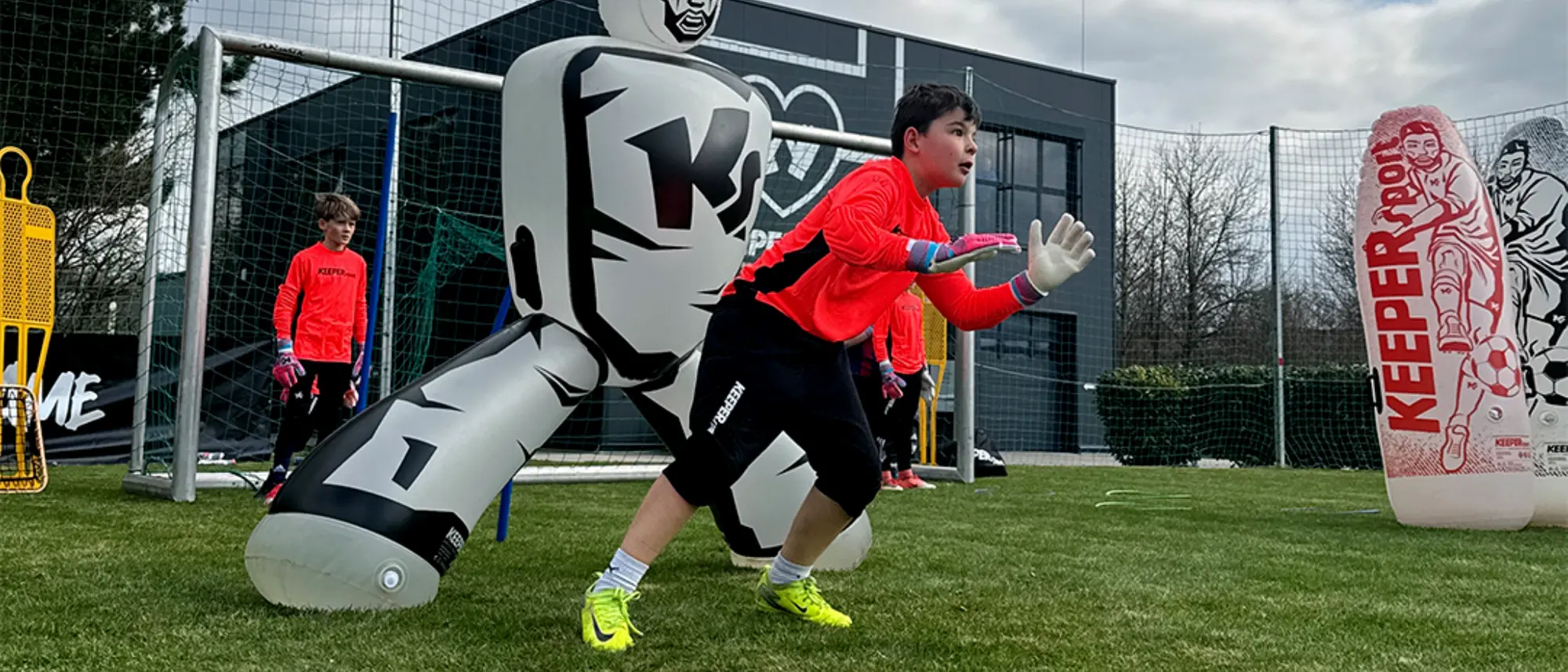
Your child stretches out with all their might to reach the ball – and beams with joy afterwards
You know the feeling. That moment when a young goalkeeper makes his first save. Not because he had to. But because he wanted to.
Goalkeeping is a special position. Those who choose it do so voluntarily, often with passion, sometimes with a touch of stubbornness that stays with good goalkeepers for life. Your job as a coach or parent isn’t to turn this child into a professional. Your job is to ensure that this passion grows, rather than being stifled by the wrong training or unrealistic expectations.
What you need for this: a proper understanding of how young goalkeepers really learn, and what makes the difference between a child who eventually gives up and one who, years later, still eagerly takes their place between the posts.
Why children’s goalkeepers aren’t just smaller versions of adults
The most common mistake isn’t made on the pitch. It happens in the mind. Many coaches and parents see a child in goal and automatically apply adult standards: holding their ground, closing down angles, making long throws. The problem with this is that a child’s nervous system, brain and motor skills are still developing.
What this means in practical terms:
Coordination before strength. Up to around the age of 12, the window for developing coordination is wide open. What is established during this phase stays with them. Strength training at this age achieves little; motor variety achieves a great deal.
Learning through movement, not through instruction. Children process information differently to adults. Too many corrective comments at once are overwhelming. A single clear focus point per session works better than five simultaneous pointers for improvement.
Emotion before technique. A child who is having fun learns faster. A child who is afraid of making mistakes learns more slowly. The emotional state is not a side effect of training; it is its foundation.
The 4 stages of development in youth goalkeeping training
Not every child of the same age is at the same stage. But these broad stages will help you set realistic expectations and structure training effectively.
Stage 1: Getting started (6 to 9 years) – It’s all about playing
At this age, the only goal is to create positive experiences. The child should love the ball, not fear it. They should be laughing, not just going through the motions.
What you do:
- Small goals, soft balls, short distances
- Lots of variety, little repetition of the same sequence
- Celebrate every save, let mistakes pass without
comment - Game-based activities rather than drill-based training
What you don’t do:
- Correct
technical details- Focus on results (“you’ve conceded three goals today”)
- Make comparisons with other children
Phase 2: Foundations (9 to 12 years) – Consolidating patterns
This is when the body begins to permanently store motor patterns. What is learnt correctly now will not need to be laboriously unlearned later. What is ingrained incorrectly now will become deeply ingrained.
Focus:
- Basic stance and flow of movement (side steps, defensive movements)
- First crosses and high balls
- Ground contact and falling technique: safe, not elegant
- First simple communication cues (“KEEPER!”, “MOVE!”)
Important: Still more praise than correction. Give technical pointers, but sparingly – one per session.
Phase 3: Deepening (12 to 15 years) – Understanding comes into play
The child becomes a teenager. Thinking becomes more abstract, self-awareness stronger. Now you can start explaining the ‘why’ behind techniques, and you will be listened to.
Focus:
- Anticipation and reading the game: When do I come out, when do I stay?
- Penalties and one-on-one situations
- Goal kick and opening up play
- Communication as a leadership tool
- Mental fundamentals: Dealing with mistakes, concentration
This is also where specialisation makes sense: goalkeeper-specific training, if possible with a goalkeeping coach or at a goalkeeping school.
Phase 4: Transition (15 to 18 years) – The goalkeeper takes shape
Physical, technical and mental aspects now come together. Development is never complete, but the foundations have been laid. Anyone who has been properly supported up to this point has a solid foundation.
Focus:
- Complex game situations: movement off the ball, offside management
, reaction under cognitive pressure
, positional play and tackling
, initial in-depth video analysis and self-reflection
What makes for good goalkeeping training for children
Fun isn’t a bonus, it’s a must
That sounds obvious. It isn’t. Many training sessions for young goalkeepers consist of shooting drills where the child stands in goal for ten minutes, conceding, conceding, conceding, and then goes back to the group. That is not goalkeeper training. It is demotivating goal-counting.
Good sessions are short, varied and end on a positive note. It’s better to have three focused blocks of eight minutes each than to stand for 25 minutes at a stretch.
Don’t punish mistakes, use them
A child who is afraid of making mistakes will no longer take risks. A goalkeeper who no longer takes risks will not develop further.
The correct reaction to a mistake in training: a brief, factual description, immediate repetition, then move on. No sighs. No body language that says “not again”. No comparison with the last time.
The question regarding the mistake is not: “Why did you do that wrong?” But rather: “What will you do differently with the next ball?”
Parents on the sidelines: less is more
This is a delicate matter, but an important one. Parents who get caught up in the excitement with every shot, shout along with the players and analyse the training session after the match mean well. Nevertheless, they are not helping. Sometimes they do more harm than good.
A child who knows, “Mum is watching and I mustn’t make any mistakes,” is under pressure that prevents learning. The best support from the sidelines is cheering when things go well, and staying silent when they don’t.
After training or a match: first ask how the child themselves felt. Don’t jump straight into an analysis.
3 drills that really work for children
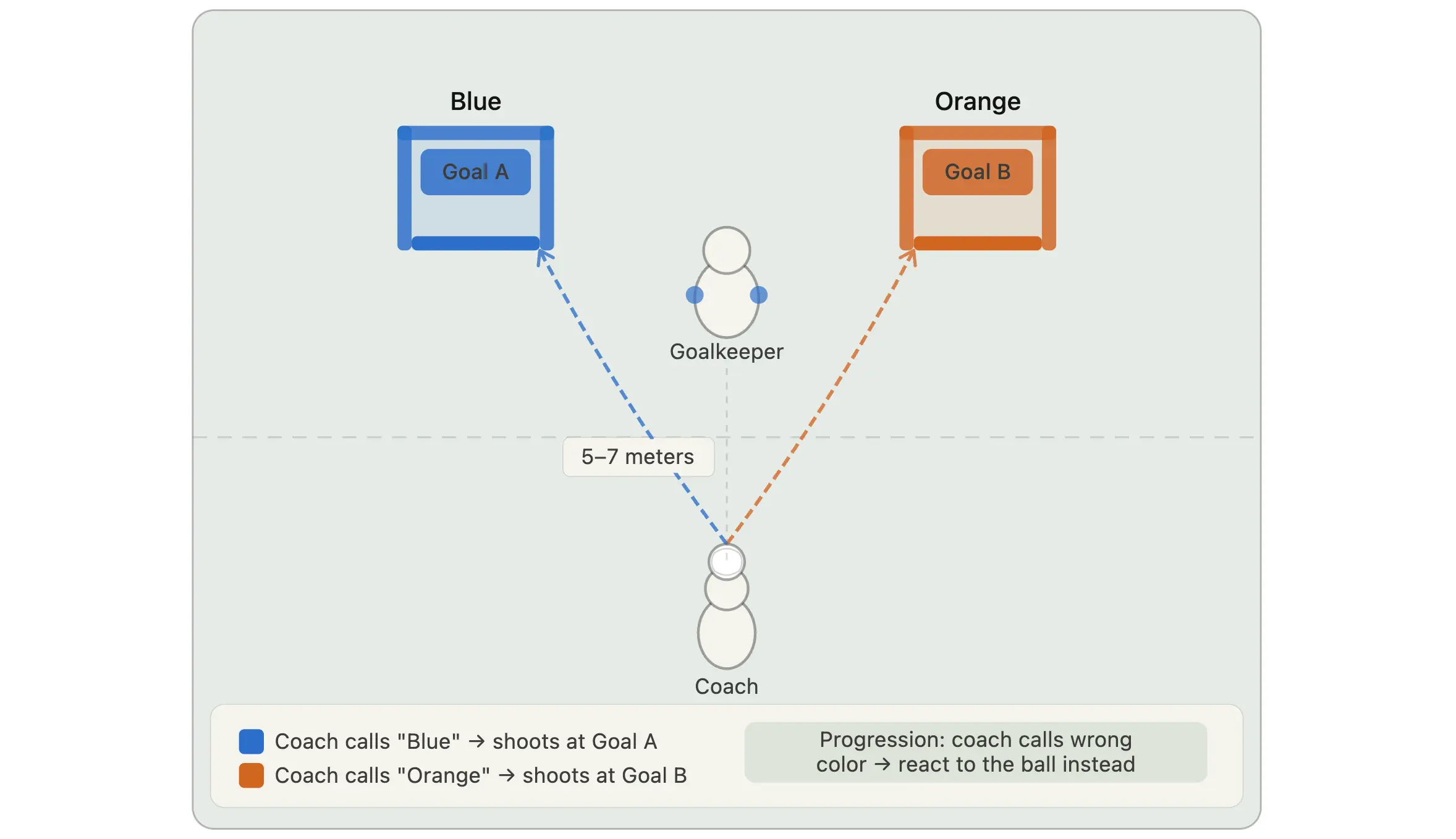
Drill 1: Colour goal reaction (ages 8 and over)
Set-up: Two small goals side by side, marked differently (e.g. with coloured bibs). The coach stands 5–7 metres away with the ball.
Procedure: The coach calls out a colour and shoots at the corresponding goal at the same time or shortly afterwards. The child must move in the correct direction.
Why it works: The child reacts to a real stimulus rather than an expected shot. The exercise trains reaction and decision-making at the same time, without seeming complex. And it’s fun.
Variation: The coach calls out the wrong colour but shoots in the other direction. The child should react to the ball, not to the call.
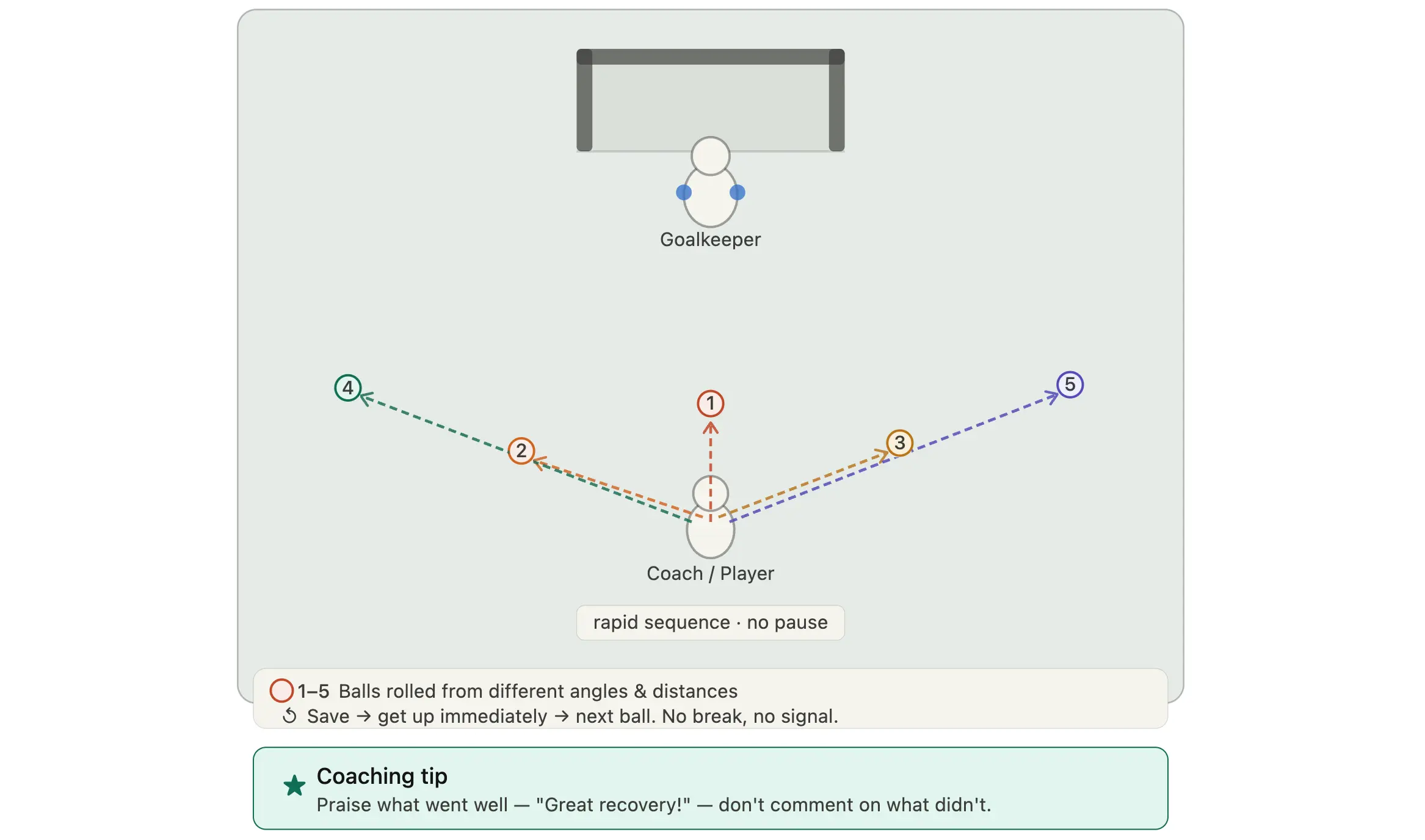
Drill 2: Rolling Ball Mayhem (ages 7 and up)
Setup: The coach or a teammate rolls several balls towards the goal in quick succession, from different angles and distances.
Procedure: The child saves the ball, gets straight back up, next ball. No signal to pause, no preparation. Just react.
Why it works: Rolling balls are manageable for children; the speed is adjusted and the pressure to succeed is low. At the same time, the rapid sequence trains recovery speed: get up, focus, next action. This is exactly what matters in the game.
Coaching tip: Praise what went well (“well done getting back up!”), don’t comment on what didn’t work.
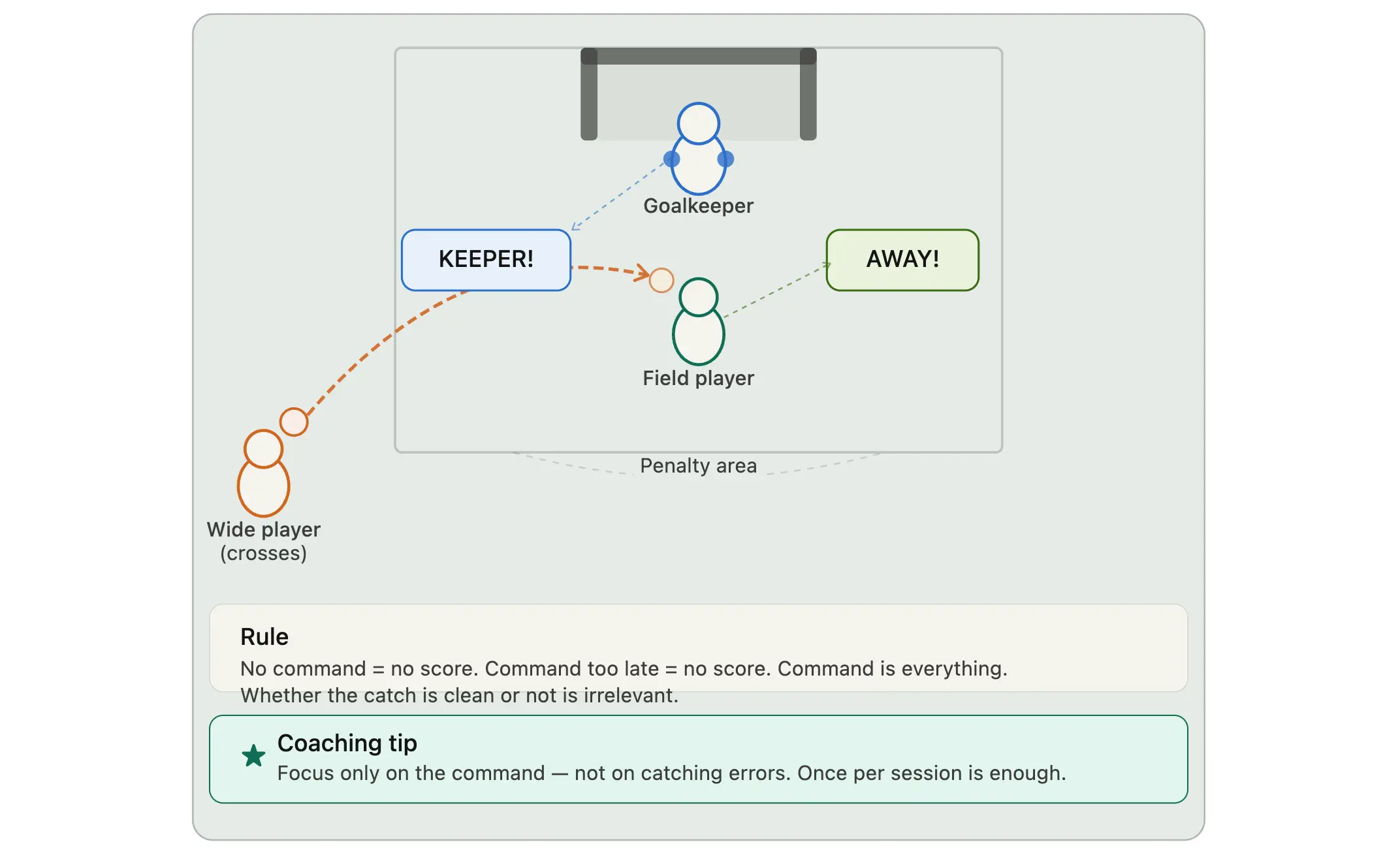
Drill 3: Communication Cross (ages 10 and over)
Set-up: A throw-in taker crosses from the side, a field player stands in the penalty area. Before each action, the young goalkeeper must either shout “KEEPER!” (if he’s going for the ball) or “CLEAR!” (if the field player should clear it).
Procedure: No command, no mark, whatever happens. Command too late? Also not marked.
Why it works: Communication in the penalty area is the most uncomfortable thing of all for many young goalkeepers. This drill makes it a requirement, without pressure. After two weeks, the call comes automatically.
Important for coaches: Don’t focus on catching mistakes. Focus only on the command. Once per session is enough.
Mistakes to avoid from today onwards
Too much technique too soon. An 8-year-old doesn’t need a perfect basic stance. They need positive experiences with the ball. Technique will come once the basics are in place.
Sessions that are too long. 20 to 25 minutes of focused goalkeeping training is enough for under-12s. Any more leads to exhaustion, not development.
Comparisons with adults or professionals. “Neuer does it like this” is not motivation for a 9-year-old. It’s too much to ask.
Debriefing the child after every match. Children process match experiences differently. Immediately after the final whistle is rarely the right moment for analysis. Let the child settle down first.
Pressure through observation. Parents and coaches who comment on every move put the child under pressure to perform. This is the opposite of a learning environment.
What the goal means to children, and what you make of it
For many children, being a goalkeeper is more than just a position. It’s their identity. Whoever wears the gloves is the only one who makes the decisions, the only one who fails, and the only one who makes the saves.
That’s a lot to bear for a child who is still learning to cope with pressure.
Your job as a coach or parent isn’t to take that pressure away. You can’t do that anyway. Your job is to create an environment where the child learns to cope with that pressure whilst still having fun.
A young goalkeeper who, at 14, still smiles when he puts on his gloves is worth more than one who, at 14, is technically perfect but has long since given up inside.
Encourage the former. The latter will follow naturally.
Conclusion: Patience is the most important training method
The best young goalkeepers aren’t made through the most intensive training. They’re shaped by consistent, age-appropriate support from coaches and parents who know when to step in and when to let go.
Fun, repetition, positive reinforcement, patience. These aren’t just soft factors. This is a training philosophy.
Anyone who takes this to heart isn’t just giving a child a good education. They’re giving them a reason to come back tomorrow.
Stay up to date
Read more:
- Improving your reaction time: How to train like a pro – the right drills for quick
reflexes- The goalkeeper as a leader: Why communication decides matches – building
communication in goal from the outset- Ready when it counts: How to prepare optimally for your next match – mental and physical match preparation