You train a lot. But are you training the right way?
Your teammate plays for 90 minutes. You make decisions in 90 milliseconds. The same warm-up routine, the same endurance session, the same strength routine. And then you wonder why you’re not really improving after the break. The problem isn’t your effort. The problem is that you’re confusing goalkeeper training with outfield player training.
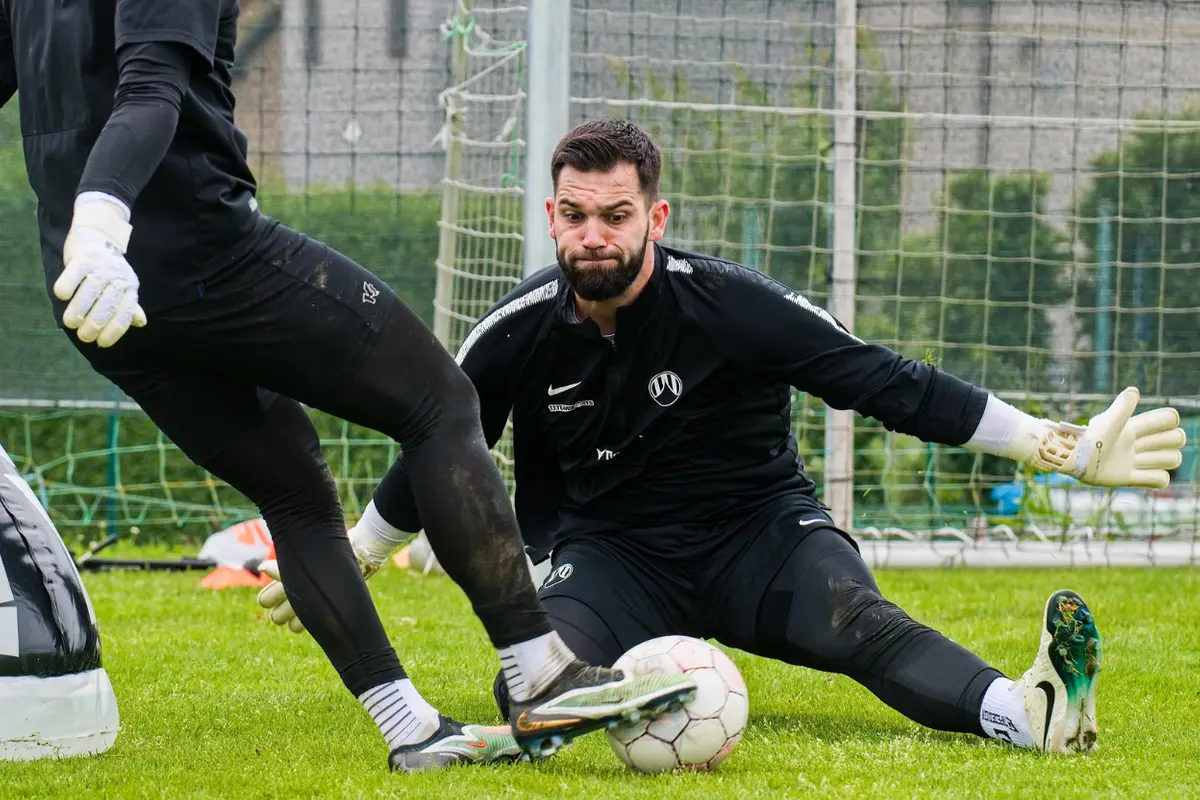
The basic principle: a goalkeeper is not an outfield player wearing gloves
A field player trains for sustained exertion: endurance, pressing, running. His body learns to maintain a consistent level of performance over 90 minutes.
Your body has to learn something completely different: 89 minutes of readiness. Then 0.3 seconds of absolute maximum effort. Then readiness again.
This isn’t an endurance issue. It’s a neurophysiological issue. Your nervous system needs to train to switch to 100% from a standing start, without a run-up, without warning. Anyone who tries to solve this with general athletic training is missing the point.
The difference in a nutshell: outfield players train capacity. Goalkeepers train responsiveness.
What goalkeeper training actually trains
1. Reaction is not a reflex
The most common misconception: reaction is innate. Either you have it, or you don’t. That’s not true.
Reaction time consists of two parts: neurological processing speed (which can be changed to a limited extent) and anticipation (which is highly trainable). Professional goalkeepers who save penalties or dominate one-on-one situations do not react faster. They read the game earlier.
This means: goalkeeper training must train perception, not just the body. Drills where you react to a signal are level one. Drills where you anticipate the correct action based on body signals, run-up angles and game situations are the actual goal.
Why it works: Your brain builds patterns. The more different shooting situations, attacker postures and game scenarios you have processed in training, the quicker it recognises the situation in a match before your conscious mind intervenes.
2. Explosive power rather than endurance
Goalkeepers don’t need strength endurance. They need maximum explosiveness over short distances: the lateral leap to the far post, the explosive rush out to meet a cross, the take-off after a split step.
This is speed training, not traditional strength training. Squats and deadlifts have their place, but only insofar as they improve jumping power, speed of change of direction and body tension during the take-off.
A goalkeeper who can manage 20 heavy squats isn’t necessarily a better goalkeeper. A goalkeeper who can change direction in 0.4 seconds after a split step certainly is.
Why it works: explosive strength training activates fast-twitch muscle fibres, which are hardly used during slow, continuous exertion. It is precisely these fibres that are crucial for your save situations.
3. Cognitive challenge as part of training
Normal training is physically demanding. Good goalkeeper training is both physically and cognitively demanding.
If you always know where the next shot is coming from in training, you’re practising execution, not decision-making. In a match, you don’t know the direction. You don’t know whether the attacker will shoot or pass. You don’t know whether the cross will be short or long.
This means: goalkeeper training must incorporate uncertainty. Two-on-one situations where you have to distinguish between a shot and a pass. Crosses with variable delivery points. Shots where you only receive information about height or angle at the last moment.
Why it works: Decision-making training under pressure has been proven to be more effective than pure technical training under controlled conditions. Your brain learns to process real match situations, not training situations.
3 drills that are specifically designed for goalkeepers
Drill 1: Two-signal reaction
Set-up: The coach stands with two balls; the goalkeeper is in the ready position. Before shooting, the coach gives either a colour signal (two different cone colours mark each half of the goal) or a body signal (shoulder rotation left/right).
Procedure: The goalkeeper should react to the body signal, not the ball. Anyone who only jumps when the shot is taken must repeat the drill.
Why it works: You are actively training anticipation rather than a reflex reaction. After four to six weeks, you will automatically jump earlier in a match because your nervous system has learnt to prioritise body signals.
Drill 2: Explosive split step with change of direction
Set-up: Goalkeeper in the centre. The coach or second goalkeeper stands 3 metres away and points in the direction with a finger or a cone just before throwing the ball.
Procedure: The goalkeeper performs the split step when releasing the ball; the decision on direction is made whilst the ball is in the air. No forward movement is permitted before the signal.
Objective: To reduce reaction time through correct movement. Anyone who does not perform the split step consistently will immediately notice that they can no longer reach the side.
Why it works: The split step keeps your body in an active, tense state rather than a static stance. The difference in reaction time is a measurable 80 to 120 milliseconds, which, in the case of a penalty or a close-range shot, means the difference between a save and a goal conceded.
Drill 3: Decision-making drill: shoot or pass
Set-up: Two attackers, one goalkeeper, no defenders. Attacker A has the ball outside the penalty area, attacker B is positioned on the penalty spot. No signal as to who shoots or passes.
Procedure: The goalkeeper decides independently: come out if the player is dribbling? Stay on the line if a pass is likely? Dive if a direct shot is taken? After each action: immediate feedback from the coach on which decision would have been correct.
Objective: To read game situations under genuine uncertainty. Repeat the same starting position ten times with different finishes until you recognise the patterns.
Why it works: You’re practising the real difficulty of goalkeeping – not the rebound, but the second before it.
The most common mistakes in goalkeeper training
Too much outfield player training: Endurance runs and general fitness training have their place, but they can never replace specific goalkeeping training. Anyone who spends 80% of their training time on general sessions will improve 80% of the things that matter least in a match.
Drills without uncertainty: If the goalkeeper always knows what’s coming, they’re practising execution, not decision-making. At least half of goalkeeper drills should begin with a genuine information gap.
No focus on the split step: Most goalkeepers skip the pre-activation. In a match, this costs milliseconds that cannot be recovered. Incorporate the split step into every single drill until it becomes automatic.
Too fast, too difficult: Complex decision-making drills without a technical foundation overwhelm goalkeepers and create bad habits. First, perfect the technique; then introduce pressure and uncertainty. Not the other way round.
Conclusion: Train like a goalkeeper, not like an outfield player
Goalkeeping is the only position where a single mistake can decide the outcome of a match. That calls for training that takes this reality seriously.
No other player has to make the right decision in a fraction of a second after 89 minutes of readiness, be physically as explosive as possible and radiate calm at the same time. This isn’t an athleticism problem. It’s a training design problem.
Train what you really need. Not what is easiest to measure.