62nd minute. 1–0. Corner for the opposition.
You’ve had hardly anything to do since half-time. Your legs are cold, your body’s in standby mode. The ball sails into the six-yard box. You take off, jump, and collide with the striker in mid-air. You land awkwardly. A sharp twinge in your groin.
You stay on. On the next high ball, you’re half a step too late getting up.
Injuries in goal feel like bad luck. Most of the time, they aren’t. They occur where the body isn’t prepared for what goalkeeping demands of it: explosive leaps, hard landings, changes of direction from a standing start. That is precisely what athleticism in goalkeeping is all about.
Why athletic training works differently for goalkeepers
A field player runs many kilometres during a match. Their training focuses on endurance, speed work and pressing.
Your game is different. You have few actions, but each one is intense: jumping from a standing start, the flight phase, landing on your hips and shoulders, then getting back up straight away. In between, there are long periods of inactivity. Your body has to explode from a standstill and then absorb the impact cleanly.
Any goalkeeper who does running laps is training for a game they don’t play.
Why this is important: for you, athleticism is both performance and insurance. The same body that jumps explosively must control the landing afterwards. Anyone who only trains their jumping power and forgets about the landing is building a powerful engine without brakes.
The four pillars of goalkeeping fitness
Athleticism isn’t simply about ‘being fit’. For goalkeepers, it consists of four interlinked components.
Explosive power. The first step and the take-off. It’s not about how much power you have, but how quickly you can access it. Jumps, short sprints and explosive strength exercises are your tools here.
Core stability. Your core transfers the power from your legs to your arms and hands. During the flight phase, it keeps your body straight and under control. Upon landing, it protects your lower back.
Mobility. Your hips, shoulders and ankles need a full range of motion. You must be able to get deep into the starting position and reach out far. If you lack mobility in your hips, your groin and back will take on the work they aren’t designed for.
Landing and falling. The most underestimated pillar. Every save ends on the ground. If you don’t train falling as a technique in its own right, you’ll end up landing on your elbows and the tips of your shoulders, week after week.
Why it works: The pillars are interdependent. An explosive take-off will only get you further if your core keeps you stable in the air. And the best flight phase is of no use if the landing takes you out of training for three weeks.
Common goalkeeping injuries and how to prevent them
Goalkeepers sustain injuries differently to outfield players. They suffer fewer muscle strains whilst sprinting, but put more strain on their fingers, shoulders, hips and back. The good news is that you can specifically address most of the causes during training.
Fingers:
Cause: hard shots onto outstretched fingers, incorrect hand position.
Prevention: proper catching technique, training grip strength, wearing the correct size of glove.
Shoulder:
Cause: landing on the tip of the shoulder; overhead movements.
Prevention: fall training; strengthening the shoulder muscles.
Groin and hips:
Cause: pushing off, explosive lateral movements, stiff hips.
Prevention: strengthening the adductors, hip mobility.
Knees:
Causes: Landing after jumping for high balls, collisions.
Prevention: Landing drills, keeping the knee stable above the foot.
Lower back:
Cause: frequent landings, weak core.
Prevention: core stability
Ankle:
Cause: Twisting the ankle whilst pushing off.
Prevention: Balance and stability exercises.
A structured warm-up is the simplest form of prevention there is.
Why this is important: if you know where your body is under the most strain, you can train precisely those areas. And if the pain doesn’t go away after a few days, get it checked out by a doctor or physiotherapist. Gritting your teeth isn’t a sign of quality in goal.
The most common mistakes in athletic training
Running sessions instead of sprints. Endurance runs won’t make you faster off the mark. Your game thrives on short, all-out bursts of action, so train accordingly.
Just the take-off, no landing. Vertical jump without proper landing technique increases the risk rather than reducing it. Every jumping exercise requires a controlled landing.
Warm-up for high balls. If you start your warm-up with crosses and diving headers, you’ll be jumping with cold muscles. Mobilise and activate first, then jumps, then balls.
Intense fitness training just before the match. An intense strength session the day before the match robs you of precisely the explosiveness you need at the weekend.
Ignoring recovery. Explosive power develops during rest periods, not through repetition. If you carry on jumping whilst tired, you’ll develop poor movement patterns.
An adult-style programme for young goalkeepers. For young goalkeepers, coordination, body weight and clean technique take priority over extra weight.
3 exercises for athletic performance and injury prevention
Drill 1: Jumping and landing
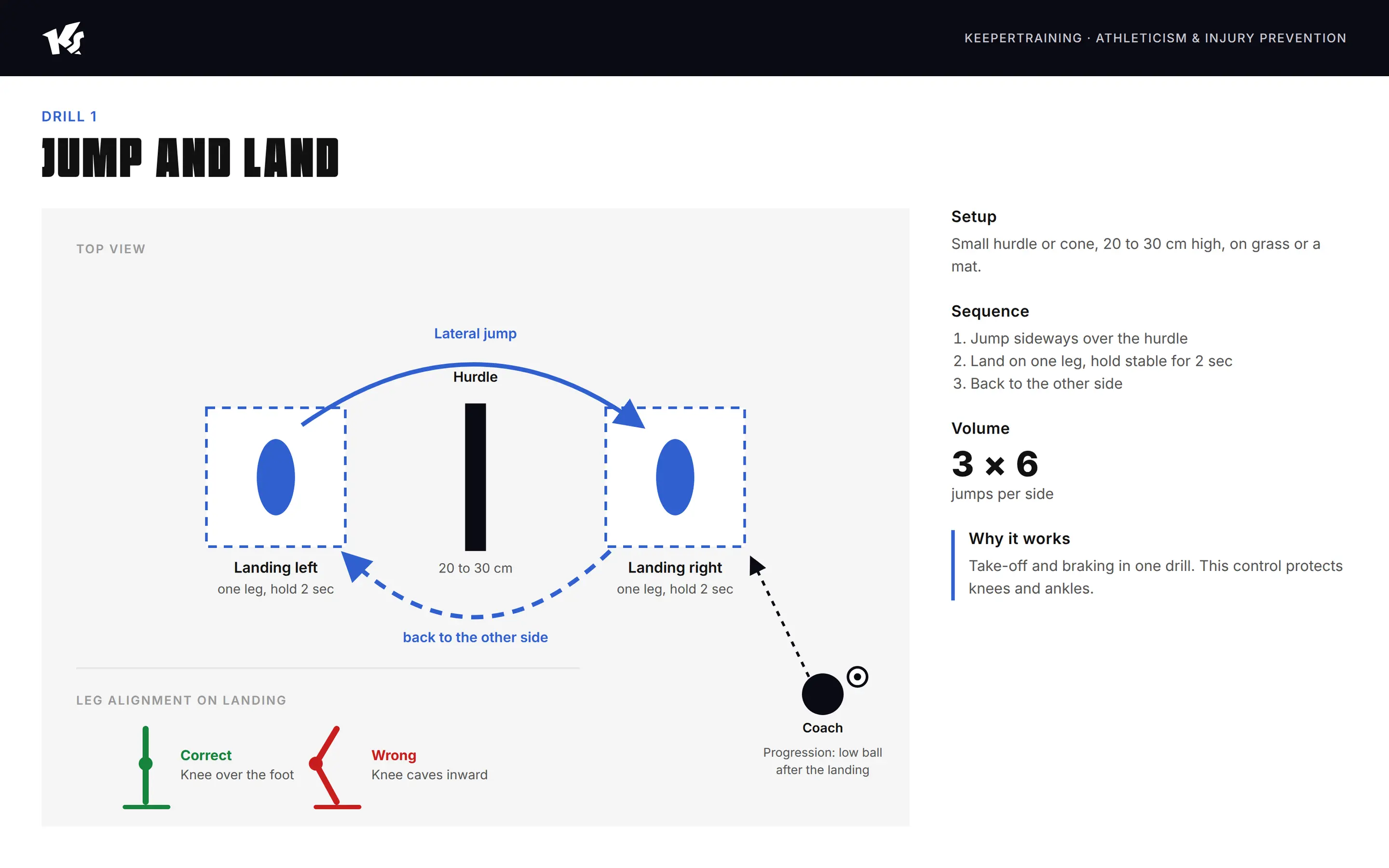
Set-up: A small hurdle or cone, about 20 to 30 centimetres high, on grass or a mat.
Procedure: Jump sideways over the hurdle, landing on one leg. Hold the position steadily for two seconds, keeping your knee above your foot and ensuring it does not cave inwards. Then repeat on the other side. 3 sets of 6 jumps per side.
Progression: Immediately after landing steadily, the coach plays a low ball to you, which you catch cleanly.
Why it works: You’re practising both take-off and braking in a single exercise. It’s precisely this control that protects your knees and ankles when you land under pressure after jumping for a high ball.
Drill 2: Falling techniques in three stages
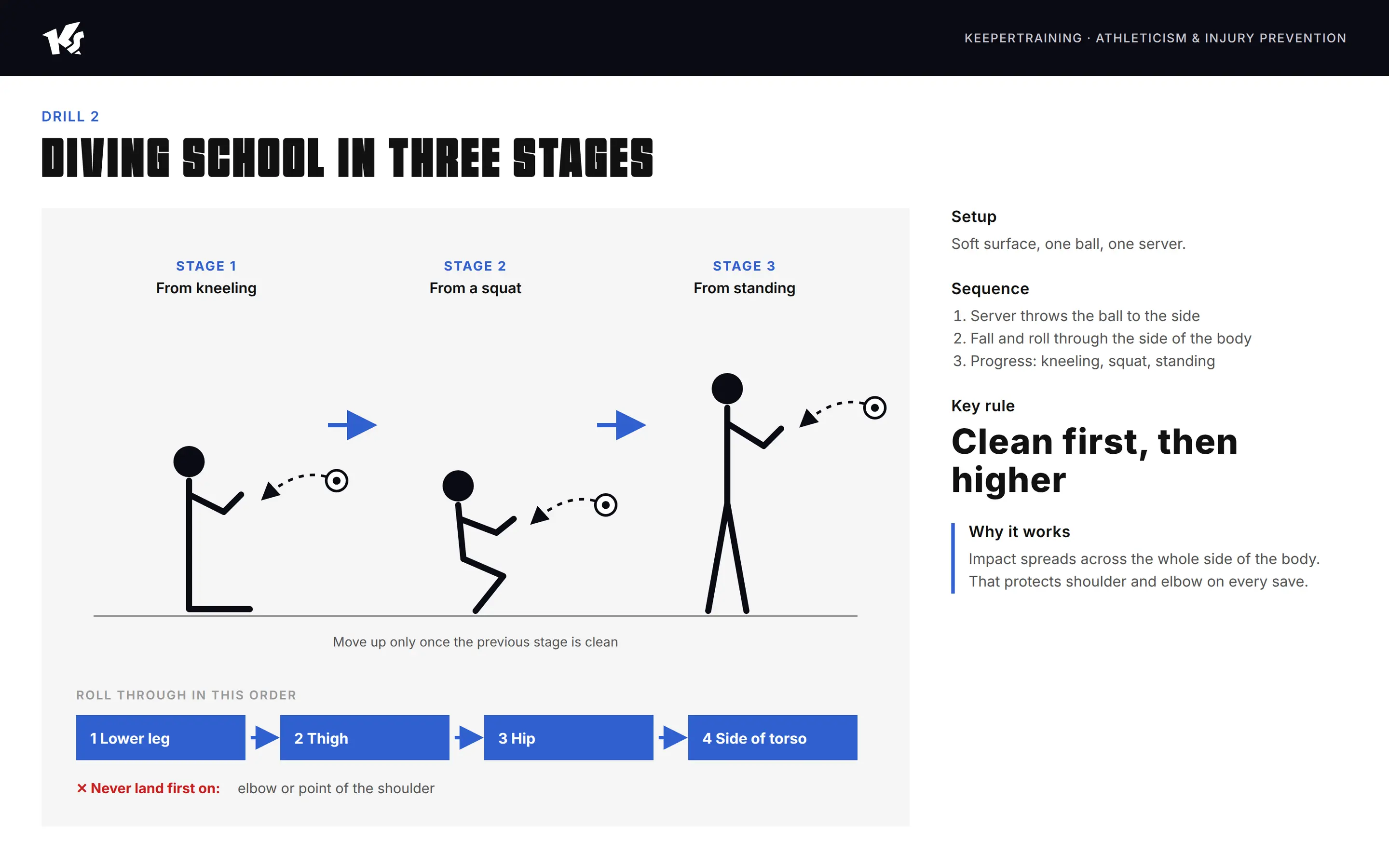
Set-up: Soft surface, one ball, one passer.
Procedure: Level 1 from a kneeling position, Level 2 from a squatting position, Level 3 from a standing position. The ball is thrown in from the side; you fall and roll down via your lower leg, thigh, hip and the side of your upper body. Your elbow and the tip of your shoulder must not touch the ground first. Only once you’ve mastered one stage should you move on to the next.
Why it works: Falling becomes an automated technique rather than a matter of chance. By distributing the impact force across the entire side of your body, you protect your shoulders and elbows with every single save.
Drill 3: Getting up, second save
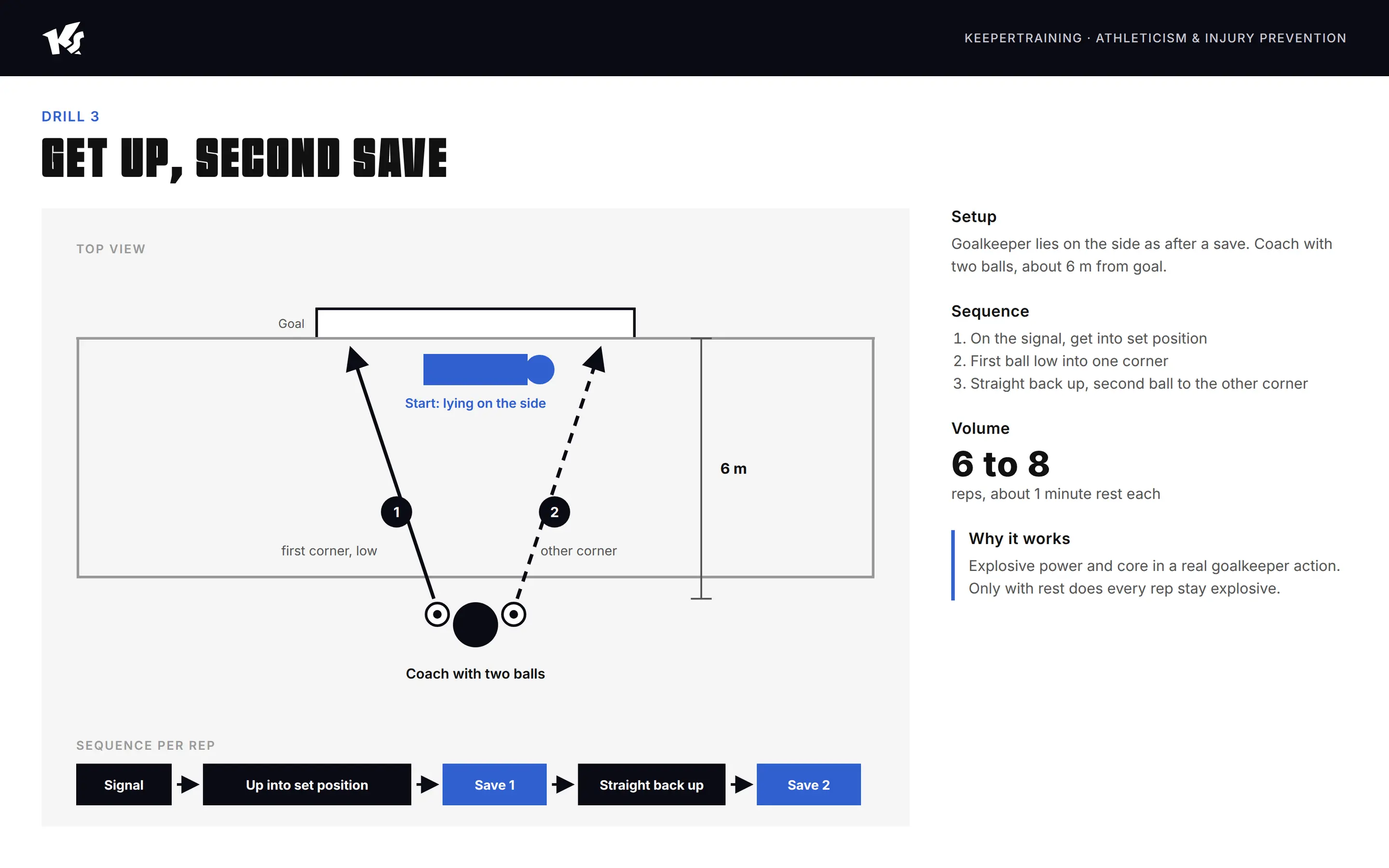
Set-up: You are lying on your side on the floor, as if after a save. The coach stands about 6 metres in front of the goal with two balls.
Procedure: On the signal, get into your starting position as quickly as possible. First ball, low into one corner; make the save, then get back up immediately. Second ball into the other corner. 6 to 8 repetitions, with a break of around one minute between each set.
Why it works: Follow-up shots decide matches. This drill combines explosive power and core stability with real goalkeeping action. The break is not a luxury: only by resting can each repetition remain explosive.
Your fitness checklist
✅ Train short, explosive movements instead of running laps
✅ Finish
every jumping exercise with a controlled landing ✅ Practise falling as a separate skill, from a kneeling position to a standing
position ✅ Warm up in the correct order: mobilise, activate, jump, then balls
✅ Avoid high-intensity conditioning the day before a match; take breaks between explosive repetitions
Conclusion: The best save is the one after which you get back on your feet
The moment in the 62nd minute isn’t decided in the air. It’s decided in the weeks leading up to it, during which you’ve trained – or perhaps not – your take-off, landing and stability.
Athletic training makes you more explosive. And it keeps you on the pitch. If you specifically train your vertical leap, core strength, mobility and landing technique, you’ll jump higher, land more securely and be ready for the next ball straight away.
Always stay up to date
Frequently asked questions about athletic training and injury prevention for goalkeepers
As a goalkeeper, how often should I do fitness training?
Two to three short sessions a week are enough, each lasting 20 to 30 minutes. These can easily be incorporated into the usual goalkeeper training. The most intensive session should not be scheduled for the day before the match.
Do I need a gym for that?
No. Using your own body weight, mini resistance bands, cones and a small hurdle, you can cover the most important exercises. What matters is performing the exercises correctly, not the weight.
At what age does it make sense to start athletic training?
You can start practising coordination, jumps and landing techniques at an early age, in a playful way and using your own body weight. Additional weights should only be introduced once your technique is sound, and ideally under supervision.
What’s the best way for a goalkeeper to warm up?
First, mobilisation exercises for the hips, shoulders and ankles, then activation of the core and legs. This is followed by jumps and simple falling exercises, with ball work of increasing intensity only at the end.
What should I do if I have pain in my finger, shoulder or groin?
Take a break and don’t just grit your teeth and carry on. If the pain doesn’t improve after a few days, get it checked out by a doctor or physiotherapist.